


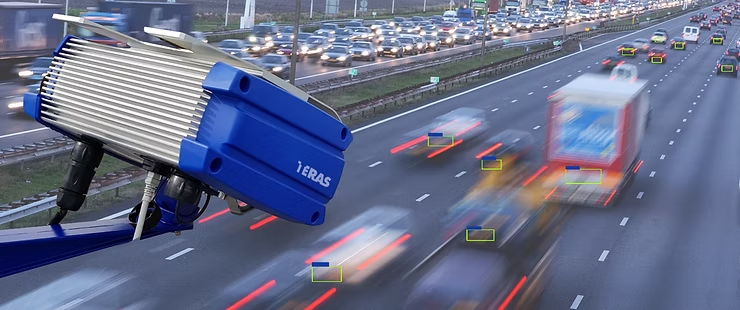
The highway industry is one of the oldest industries in the world and full of innovation. The use of computer vision in highway industries has been around for many years and it continues to grow with new innovations being developed all the time. Computer vision systems are able to make sense out of complex visual data such as images, videos and text-based information more accurately than humans ever could manually do so. This article will give an overview about how computer vision works within highway industries where it can be used for traffic monitoring purposes, navigation, and anomaly detection among other things.
The potential for computer vision is immense. It allows for accurate tracking of multiple objects and its use in this industry is only just beginning to be explored. As the technology improves, so will our ability to accurately track and analyze data from vehicles on the road. This can be used in many different ways:
These cameras capture images of vehicles and surrounding environments which are then processed by machine learning algorithms. Machine learning is a type of artificial intelligence (AI), and these algorithms can be used to make predictions based on trained data sets. By using machine learning, the system detects objects in an image, classifies them into different categories (such as cars, trucks, or pedestrians), and determines how they should react when they encounter each object.
Besides, machine learning uses these inputs to make predictions based on trained data sets. To train the system, we need a lot of training data that contains both the input and output values. This is then used by machine learning algorithms to create a model. The input data can be anything from raw images, video frames or even time series data such as temperature readings over time for IoT devices like cameras in highway traffic monitoring systems.
The ability to track hundreds of objects simultaneously is a major benefit of computer vision over manual methods. This is especially true in situations where vehicles, pedestrians, animals, and other objects need to be monitored. Moreover, the ability to detect anomalies in the environment by using computer vision systems can be very useful for highway industries such as construction sites.
It is also very cost effective as it does not require high amounts of human resources to monitor on-site. The system can be configured with various sensors that provide feedback about road conditions such as surface friction, potholes, or debris. This information can be used to inform the driver about upcoming hazards in time for them to take corrective action.
Computer vision is a very powerful technology that can be used for many different purposes. The applications of this technology in highway industries are just the beginning, there will be many more ways that computer vision will change the highway industry as we know it today.
In fact, TERAS has already implemented computer vision solutions for Malaysian highway operators, such as license plate recognition to support toll payment accuracy, and automated vehicle counting / classification. At TERAS we strongly believed that this technology will play a significant role in the next evolution of the highway industry and we’re excited to already be part of this journey!